Showing posts with label melbourne. Show all posts

Thursday, March 9, 2017

Female Light Signals in Victoria: Equal Lights

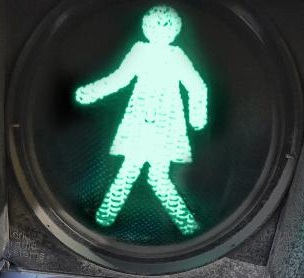
I think that while it's quite easy to sit there and criticize a new implementation that has been introduced in Melbourne, it's worthwhile to have a think about it overnight, and wake up the next morning and say, hey, Melbourne, good on you for introducing that new implementation: an additional gendered silhouette:


For those of you who do not know Melbourne, those internationally residing or nationally residing and who have no geographical inclination whatsoever, Melbourne is the New York of Australia, nestled neatly at the bottom of the Land Down-Under, overrun with easygoing cafes and lovely bearded men. And now this lovely urban cesspool of hipsters and blue-collar workers who despise greenies (for those of you who don't know who the 'greenies' are, they are a government party who care for... a lot. They just care so much that others have chosen not to care about them) have another reason to despise greenies, because of this so-called 'embarrassing' attempt at gender equality. The greenie in particular being Misha Coleman, pictured below, the white lady who fell for the 'Green Lady':

The irony. A greenie lady fighting for a green lady. She justified her support of the green lady by saying that, “from when kids are young enough to walk they are given an instruction by a man and it has never occurred to any of us that that is inherently so bias. [...] I’m a mother of two young children and we always talk about waiting for the ‘green man’." So perhaps it is time for kids to wait for 'green woman' too?

One would think that people would be impartial to the adding of a different light. However, much like the whole pushing-forth-gender-equality movement, adding a dress to an otherwise undressed crossing figure has sparked outrage. I have heard the most preposterous reactions to this light, particularly from one fellow who claimed that you have to be dressed like Mary Poppins to cross the road. Well, prior to the installation that light, did you have to be a buff, nude and bald man to cross the road? And if this fellow wishes to further argue, I can argue that he cannot cross regardless, lest he had no toes nor fingers nor a nose because hose are the features that the lit up green and red man lacks. And this 'Mary Poppins' light is not representing Mary Poppins at all, though I do appreciate the fellow's sense of humour: it is a silhouette of Mary indeed, but Mary Rogers, the first female elected to local government. But that is beside the point - that light was added to a suburb in Melbourne, Richmond, in May 2016. It was to commemorate her contributions to council including Victoria's first maternal and child health service - that is to say that this fellow's argument is a year old, redundant, and highly inconsiderate:


And all that fuss over one light - ONE light. Look how happy the fellows above are, why can't this fellow be, too? I mean, really, if that light is so difficult for you to accept, perhaps you should have your social equality epilepsy diagnosed before it grows out of control.


I digress. Back to the topic at hand: Misha Coleman has pushed the idea that gender equality may be accessed through the adding of more female figures in the little boxes that help colour-identifying humans cross the roads as safe and civilized pedestrians. Thankfully for Cr Coleman, the Committee for Melbourne has answered her social prayers, however, much to the dismay of the community of Melbourne.

And, to think, that all the fuss is about an adding to a triangular shape to a male-figure shape in order to entice one's mind to believe in the difference in genders. Behold; from this:


... to this!


If anything, I am outraged that society still expects to represent through semiotics, the presumption that if one were to wear a dress, one is considered a 'female' as opposed to a male who would not, presumably, wear such attire. THAT is something to be outraged over. And one cannot be outraged over that through the adding of these 'female lights' because it would be unwise, as our toilet signs also use the same silhouette to express gender differences when it comes to the public relieving of bowels. So, really, all of the outrage coming from people who think this act does not encourage gender equality is decades too late.

These lights, albeit with their constraining representations of both men and women, bring forth some positive change: "well," said the 'female' light to the 'male' light, "if they expect you to look like that, then I'll sit here because they expect me to look like this, so let's sit here together in harmony and direct these directionless citizens with two colours and hope they don't fuck up the simple task of crossing the road as much as they have fucked up gender equality already. And if they want to call this gender equality, then so be it!"

In that sense, gender equality has certainly been achieved. Both males and females are now suppressed in that they are represented by inadequately dressed (or in the case of the male light, undressed) lit up silhouettes. Now, we should try to help our children listen to both men and women in terms of road-crossing safety, as well as subliminally condition them to believe that a female should look like so, and a male should look like so. 


We are, like the gentleman below, affixing the conditioning of our society to our society. We are restricting ourselves from the freedom of self and expression. While it may have looked as though assigning both female and male lights is a solution to gender equality, we have, paradoxically, added a new negative ingredient to the concoction, instead ensnaring ourselves in a realm which wishes to control.

So, my fellow Melbournians, before you light the fire of outrage, think of what it is that outrages you. Is it the fact that you don't want a female light because adding a female light doesn't really add to gender equality? Or is is the fact that you are distinguishing between a 'female' and 'male' light in the first place?

Maybe, to put both of the above problems at ease, we should instead have LED stick-figures representing us.

Or better yet, a big green and red silhouette of Uncle Sam, to remind us how Orwell predicted the degrading of our society through technology. Not to mention the continued suppression by our government. 1984, people.


Or better yet, a big green and red silhouette of Uncle Sam, to remind us how Orwell predicted the degrading of our society through technology. Not to mention the continued suppression by our government. 1984, people.

But do not hate the initiative. Initiative can bring change. Hate the initiator, because the initiator initiated the wrong initiative. A greater initiative which would have pushed forth gender equality would be equal marriage rights. But we can't do that, because gendered lights at pedestrian crossings are more important to Melbourne and their greenies. Stop caring so much, greenies! Look at what your caring has caused! Social equality epilepsy!


Wednesday, April 2, 2014

What the F*ck? Melbournians are Fined for Public Swearing?

Oh? So a new law just came in today stating that if one swore in a public place, they would be fined $500? And people are now swearing at that law because it oppresses their sense of public freedom? 

Let me bring in a little anecdote of something that happens all too regularly on an ordinary trip to a local shopping centre - I witness teenagers in their little groups of 'cool,' using derogatory terms about homosexuals, filthy words to replace the act fornication, and even more horrid words against people of varied races and skin colours. I hear older boys swearing around younger children, deteriorating one of their aspects of innocence by the simple act of cussing. I hear the not-so-classy people wearing torn pants and a stained singlet walking around swearing at kiosks for not letting them purchase a drink which costs five cents more than they can afford.

I still remember the first time I heard the word 'f*ck'. I was in the courtyard at my primary school, in a brick-cylinder, playing with a tennis ball, slamming it against the wall and talking to my friends about our latest Pok'emon catches. All of the sudden, the 'cool' boy in year six and his gang of followers walked in. They all gathered around him as my friends and I took a step back, and we, not knowing about the greatest spectacle that was to come from this boy's mouth, eavesdropped at the very moment he said it, and we all gasped. He gave a 'cool' smile and then walked out of the brick cylinder. We just stood there, unable to accept what had just happened. Did we just hear that? Did he really just say that? Yes, yes he did. I know that from that moment, at the age of just nine, an aspect of my innocence was taken from me.

I know that things are far different now than they were in the year 2001. I know that a lot of children nine and under have access to the internet and are exposed to things that they were never meant to know until they had neared the middle of puberty, and I know that some of these kids even use those words themselves because they hear it all too often in their households. Nevertheless, if the government imposes such a fine upon filthy public vocabulary, then the hearing of these terms would be sprawled around our public sphere less, and it will slowly but surely turn into a social norm that words such as 'f*ck' and 'c*nt' are not acceptable to use in sentences to describe things in negative or positive ways, nor are they acceptable to replace words like those that describe the act of fornication, those that come before a feeling to emphasise the feeling of that feeling, nor to replace 'heck' in exclamations like 'what the heck!'

I believe that swear words have their places, such as if one was speaking to their peers in a private room in the library about an assignment that they loathe, or if someone is in a lot of traffic on their way to a meeting that had started without them thirty minutes ago, but I do not believe that it should be used around the general public where innocent ears lurk, nor towards authoritative figures like police officers when the user of those words has clearly committed an offence: police are people too, they are just far more caring about the safety of others to ignore that man who is running off with a new television from Harvey Norman, or to ignore that drunk indecent man flashing his private parts to a group of year 7 girls exiting from their highschool and taking the shortcut home through an alleyway around the corner, or that crazy woman who pressed her lit cigarette onto a young man's forearm and as he came to hit her began yelling about how he is sexually assaulting her. There are far too many problems occurring in the world for us to just stop and complain about the stripping of our freedom because of the taking away of our indecency to use words of vulgarity around others in public.

I mean, think about it, really - do you really need words of profanity in your everyday discourse? Recently, I have excluded most of my vulgar language use in my conversations due to the fact that I now work with adolescents and children, and I have found myself using varied adjectives rather than that monotonous 'f*ck' word. I have found that my sense of description is far more expansive, and that instead of saying "what the f*ck?!", "why did that just happen, I don't quite feel comfortable about how that person responded to that and I particularly don't enjoy how that saucepan had almost his me right in the head had I not ducked in time!" works far more better. It states what happened, and it states my opinion about what happened, so that a three-dimensional form of reasoning emanates from my mouth, rather than an unpretentious, overrated word.

Challenge yourself, before a $500 fine does. The world is much more three-dimensional with artistic conversation. Try to use descriptive words rather than the bland words Samuel L. Jackson uses in his film Snakes on a Plane. I mean, he says the word "motherf*cker" so much that the viewer forgets the movie is about snakes on a plane rather than a mother who keeps on fornicating. Language is beautiful, do not kill it with profanity. 

Tuesday, February 25, 2014

Lionel Shriver's Talk at Deakin Edge, Melbourne


I had one mission today - after having acquired tickets to Lionel Shriver's talk at Deakin Edge in Federation Square, Melbourne, I was to find some accompaniment. Luckily enough, I found my mother, who was willing to attend any event surrounding literature, as strangers inside the building in which this event was held were sure to be more civilised, and far more human than her in-laws.

We made it to the city without getting caught in too much traffic, and found the Deakin Edge building, tucked into the heart of Federation Square. Alas, we were greeted with a long line of excited enjoyers of Shriver's books, and we managed to blend ourselves within them, despite our very urban clothing. It was not much of a wait, and soon we found ourselves entering the building, which appeared to look like a gigantic lecture theatre. Before I went down the stairs to be seated, I scurried on to the little bookstore set up in the side of the entrance room, and purchased Shriver's newest addition to her works, Big Brother. My mother and I then hurried, withholding as much class as possible when one is rushing, back to the line which was bustling down the lecture theatre steps. 

Being the socially unprepared person that I am, I found the best seat in the theatre at the back, and being the anal person no longer afraid to take any risks that my mother is, she forced me to the front of the theatre, where two seats waited in the first row, exactly in front of the stage where Shriver was due to stand and speak. Beside me sat a dainty but tall old chap who was seated beside his wife, his right hand rested on his thigh implying their intimacy toward one another, or his unrequited love towards her. And to my right was my mother, restless, taking moments to remove her jacket and reposition herself and asked me questions, and focused on the architecture around us. It appeared she was more excited than I was, not just for Shriver but for the fact that we were sharing a literary experience together without the impatience of my sister and father. 

After a rather cheerful radio presenter revealed to us that she had read Shriver's We Need to Talk About Kevin on her very own honeymoon, Shriver finally took to the stage and saturated the audience with her take on Big Brother, about the very sad story of the passing of her own big brother due to obesity issues, and then read to us a large passage from around halfway through the book. I have not yet read the book, but from the passage read to me by Shriver and by the way she spoke of it in context aligned with her personal experiences with matters such as obesity and the obsession food, I have fallen in love with it already. Shriver has made it so appealing that I might not read it yet still recommend it, just because it indeed shows us an aspect of society that is "talked about to death".

She spoke about obesity in a soft manner, keeping in mind that she had me, the only overweight person in the room sitting right in front of her. I shifted uncomfortably in my seat a few times, which she noticed, because she touched on things too close to my heart and my experiences. Yet she was still rather consoling with her words. My mother told me that whilst I was taking notes, Shriver would slow her speech and repeat things just so she made sure that I had the chance to write them down. I had not noticed this because I was too busy trying to take in key lines, and remember them long enough to write them down and keep in mind the other key lines being said in the meanwhile. Mind you, there were a lot, and I was ever so grateful to have attended, despite being faced with touchy issues.

Amongst the touchy issue of obesity, though, was a huge sense of humour that was emitting from Shriver herself. She spoke of how, despite the horrid show Big Brother, she named her book the same thing, saying that she did so to bring the original 'big brother' back to its "first principle", which originated from George Orwell, and that it contained a pun in itself to do with the story, a big brother. She mentioned how strange it is that some journalists are obsessed with her own dieting, and the irony contained within that and Big Brother, that society is too concerned with weight and image, and society's response is to question hers. It reached an extent, she said, that while she was in her favorite hotel in London, drinking her favorite tea which came with delicious biscuits, journalists commented on whether or not she would consume those biscuits, and focussed on her exercise routine and daily consumption rather than the book itself. 

I could not think of a question to ask her when she allowed the audience to interview her. I listened as members of the audience forced their opinions of the characters contained within the book at Shriver and how they almost expected her to agree with them despite her utter knowledge of each character and the importance of each, even when one audience member attempted to highlight that there was no need for the main character, who was the narrator of the story itself - I felt that even though I had not read the book, I was knowledgeable enough about it from Shriver's perspective. That certain question was pointless. And, like always, I thought of the perfect question when it was too late.

But I found that it was not late at all, for she was waiting in the entrance room signing her book. I stood in the line, which was not at all long, and waited excitedly. When I reached her, I greeted her with a little, "hello", to which she replied the same thing. I thanked her for her insightful speech, and I asked if I could ask my late question, seeing as I conjured it after it was too late, and she told me it was perfectly fine. "Have you ever been a victim of procrastination, and if so, how do you conquer it?" "Oh, yes! Everyone is a victim of procrastination," she answered, and not necessarily authors alone. She said that the main thing is to not feel "ceremonious" towards your writing, rather feel ceremonious with the outcome. I agreed. It was all something I had known, but it feels better to hear it from a published author's perspective, so that maybe she will inspire me to begin writing. "Just begin."

Just as I thanked her, my mother asked her if she could photograph me with her. Shriver said "of course". The photo above is the outcome, and yes, Shriver appears to be sleeping. That is because the off-chance that one blinks in the photograph decided to happen tonight, especially considering I look decent in the photo for once. I thanked her for the photo opportunity. "You're welcome. That was an interesting question!" Thank you, Shriver, that was an interesting talk.

Wednesday, December 11, 2013

Romanticism and Ghosts

 Apart from the general excitement that is felt by one as they roam the world in search of paranormal happenings, one, in this case, is inextricably excited if there is some sort of romantic context involving the spirits of these persons before their mostly untimely deaths. It is thus safe to say that romantic deaths and afterlives are more appealing than regular deaths, in some scenarios.

Take for example, and for inspiration of this essay, the romantic dilemma between two in a town close to Melbourne, hundreds of years ago. A maid had fallen in love with the heir to Salisian Manor. She was from Kismet Park, not too far from his Manor. During the night times, they met near Salisian Bridge for alleged courtship, undetected by possible onlookers. Some time after, the young man was to be married. He insisted on marrying the maid, his true love, instead. Once his family found out, they refused to let him ever see her again. Due to this separation, the young heir had allegedly killed himself.

For a while, the maid did not know of her true love’s fate. Every night, she continued to wait for him at the bridge, but with no sign of him and with the knowledge of what had happened to him, she too killed herself. The legend has it that late at night, one can see the maid’s apparition wandering around Salisian Bridge, in search of her lost love.

Knowing of the bridge alone would hardly provoke one in travelling to it, unless they were interested in crossing every bridge around the world as part of some personal goal or challenge or dare or bucket-list checklist achievement. However, when one is notified of the alleged courtship and horrid Romeo and Juliet-esque love story about a wealthy young heir who had fallen in love with a maid and had killed himself after his family’s refusal, to which the news of that had resulted in the maid’s suicide too, and the add the fact that this all had happened at that particular bridge and late at night there have been reports of the viewing of the apparition of the lustful maid, then one’s interest would most likely heighten and force one to visit that place immediately, whether or not they are equipped with adequate paranormal spirit detecting devices.

One must wonder, though, after trailing this love story on the internet and finding nothing else other than a badly written synopsis as such with the word ‘heir’ misspelt as ‘air’ indicating that every site which has this synopsis had just copied it from the original site and had passed it on, so to speak, whether this story is true or not. It would be rather exciting if it were a true story because of the romanticism involved, thus indeed making the trip to this bridge an extremely awesome endeavour. However, one would say that if it was not true, one can pretend it was and have an equally awesome time at the bridge imagining the two in courtship amidst the gum trees and dry Australian shrub.

In the event that it is true, however, who told this story to the person with bad spelling skills? Was it a possible onlooker who allowed this unfortunate couple a few minutes a night to feed their courtship, and could this onlooker have grown old and told a grandson/daughter about this love story? Maybe this grandson/granddaughter had grown a liking to this story and had become the anonymous source, spreading bad grammar on the internet? Perhaps. Even so, the story itself is interesting, and it is upsetting that the bridge no longer exists due to no apparent reason – the only information as to the whereabouts of this bridge is that it was allegedly recently demolished. Its location is where the Sunbury Road from Melbourne crosses Jackson’s Creek, before the divided road is reached.


This historic site is now replaced with a mere Apex Park and an electric barbecue. One wonders what is more saddening – the replacing of this beautiful monument which had a romantic context or the romantic context itself. It is said that now the maid’s apparition is seen nightly, cooking some food in preparation of the possible arrival of her true love’s apparition.