Sunday, May 7, 2017

Get Out: bringing racial issues to a new visual surface


If you know me, you know that when the time strikes, and that time has more than once struck in the recent years that I have been both critically and socially aware of my prejudiced surroundings, both near and far, I am highly driven to verbally combat racial prejudices. When I hear of any racially-charged attack, I spend the entire day obsessing, indulging myself, reading articles and watching news reports and, if the social media world permits me, watching recorded videos of said racially-charged attack until my mind sufficiently builds up a retaliation that I infuse in a post about the attack on my share of the social media platform that is Facebook, or better yet, Blogger.

*** I WARN YOU FROM NOW ***
If you don't want spoilers, please exit stage right.
If you are yet to see the movie, please view it before reading on, and return to this post after you have, so that you do not encounter any spoilers. 


In a regular viewing, it can be noted that Get Out is a movie, in short, which depicts the African American as an icon of fashion, 'the new black', which can be bought off at a privileged white person's mansion in a fucked-up auction concealed as a Bingo game. The African American is more desirable to the buyer if they have qualities that the buyer desires: one buyer wanted to purchase the protagonist, Chris, who was lead there by his deceiving girlfriend who fetishes the African American male (and female), because he would be a great fellow golfer like Tiger Woods (who is mentioned as this scene plays along to add to the level of racism depicted), and another, who eventually ended up buying him, wanted him for his eyes and his love of photography. Another desirable trait is that the African American cannot defend themselves, as they have been brainwashed by Missy Armitage, Chris' girlfriend's mother. After being brainwashed, their speech is formed around obeying the commands of the white people, and any injustice they feel or any form of expression that does not please the white person is suppressed by the hypnosis as their free self is locked in a dark space (pictured below).


But Get Out is more than just a movie that echoes the purchasing and selling of an African American slave, the actions in which, you best believe it, actually disgustingly occurred several times in human history. It is more than just a statement, more than just a twisted horror and thriller. It is a response. It is the response we, the people in human society who actually value the idea of a utopia free from prejudices of any kind, have been desiring. We have all witnessed the increasing hate crimes that have been adding fuel to the fire of the Black Lives Matter justice-seeking movement, and this movie, arguably, may be an additional splash of fuel to that fire, allowing the fire to burn even brighter, reeling in more attention to the equality of the human race.

In fact, more than anything, I highly believe that Get Out has opened Pandora's sister's box, in that what it has unleashed is not necessarily a view of all the bad in the world alone. That would be too easy for the racially prejudiced white folk to comprehend. It would be a mere slap-on-the-wrist approach. How bland! Why show them a fictional realm of action and consequence when they are barely moved by real-life videos of consequence and consequence? Crime and punishment? Instead, Pandora's sister has come out of her rendition of the box. And finally, too. She has been waiting for the right time, and Peele's Get Out has granted her the exact moment of high power. She has the high hand, here, outing herself at the peak of the release of a new form of protest which will revolutionize the movie industry. And so, Out she Gets, wielding only one object: a mirror.

Why a mirror? Out of all the things she could be carrying? Well, you see, sometimes the best weapon is the weapon of realization. Once a wrongdoing is made, the wrongdoer seldom is explained the wrong of the wrongdoing. They are offered two forms of explanations: the first, through visuals in protest signs, and the second, through the law. But laws sound so complicated. It is easier to say, "hey, you have fucked up because you shot a person based on their skin colour you prejudiced asshat" rather than "on the count of homicide, we have found the defendant guilty". Law prefers to keep things concise. Neatly arranged so that the delivery of a sentence is fast and simple. I prefer the long, hard road of verbal explanation, because I really don't think that racist members of society are understanding how their racism is affecting their victim. They really need it spelled out to them:

S T O P   W I T H   Y O U R   R A C I S T   B U L L S H I T. 

But this is where my dear friend 'realism' steps in. Realism is a concept I have become all too familiar with in my literature studies. It basically stipulates that if you hold a mirror up to the world, its reflection is a depiction of the world itself. Kind of like a mirror in real life. But that reflection is based on where the mirror is aimed at, who is in the frame, and whose perception is being shown. Those are the controlling elements. And, in a way, Jordan Peele is holding up a mirror to a certain fraction of society, to show that small fraction of society how big their impact is, and how tired the rest of the world is with their shit.

Shit, of course, being shootings and mass shootings and crimes that have been and gone and will still come, despite the holding up of this realism mirror. Its display is, nonetheless, very important, as most of the audience who have seen this display have subliminally taken in its messages. I am here to help them surface. And this surfacing can be done with accessing my muse, which is what Get Out has precisely done. In fact, nothing has driven me closer to this form of my muse than the viewing of Peele's Get Out. Having watched most of Peele's satirical takes and contributions to the comedic world, this contribution, though comedic in a twisted way, penetrates the joy you feel when you uncomfortably laugh in the movie's very awkward-feeling-inducing scenes, and plants instead little memory chips that notify you that these are moments derived from our unfortunate realities. That these depictions are not entirely loosely-based, and that they very much are the key foci to the moral and ethical wrongs that lurk in the world's supposedly happy little suburbs, in particular, the neat and tidy suburb that the first character in the first scene of Get Out finds himself uncomfortably navigating in.

I look at that neighborhood and I see darkness, and I fear the darkness alone. But that is just me, me who has a night light in her room. Me who is scared of the night time and of black-outs. If I were walking in that neighborhood, seeing a pair of headlights will comfort me, as they would tell me that I am not alone. But from the modern-day African American male's perspective, or at least from the one depicted, I cannot help but note that seeing headlights is not a great feeling. And, like a deer in the headlights (excuse the pun but please note that there are a lot of deer metaphors contained in the movie, this being the first), he froze, and was beaten and shoved in the back of that car. His uneasy feelings in a seemingly safe looking neighborhood goes to show us, the audience, that what is safe for one person may be the direct opposite for another. Safety is no longer a universal product. It has become a trap which, if one is not too careful, can ensnare one.


It made me think of an analogy of a rabbit trying to escape. A little white rabbit, it's tail fluffing about as it frantically hops away to ensure its life is kept. And why wouldn't it, considering Flanagan and Allen's 'Run Rabbit' was playing? It made me think immediately of Australia's minority group - the Aboriginal people, who are much like America's African American people. In particular, though, I remembered the movie Rabbit Proof Fence, wherein the main metaphor that the movie screams is echoed by the quote that the rabbit-proof fence "keeps the rabbits on that side of the fence, [and] keeps the farmland on this side of the fence"; the rabbits, of course, representing the 'pests' that are the minority, and the farmland representing the oppressive and prejudiced society that works to rid itself of them. The fact that 'run rabbit run rabbit run run run' was on loop could allude to the fact that the rabbit in the song is being personified to represent the protagonist, Chris, and that he, like the rabbit, is a pest in society, and that he needs to run to ensure he is not killed.


What is particularly chilling, though, is reading the rest of the song's lyrics:

On the farm, every Friday
On the farm, it's rabbit pie day.
So, every Friday that ever comes along,
I get up early and sing this little song.

Run rabbit - run rabbit - Run! Run! Run!
Bang! Bang! Bang! Bang!
Goes the farmer's gun.
Run rabbit, run, rabbit, run.

Run rabbit - run rabbit - Run! Run! Run! 
Don't give the farmer his fun! Fun! Fun!
He'll get by
Without his rabbit pie
So run rabbit - run rabbit - Run! Run! Run!

The first verse shows, when taken metaphorically, how normal the culling of the pest is, and how constant. It is so constant that a day of the week is allocated to it. The last verse shows the animosity of the farmer, wherein even though the farmer may not harm or capture the pest, he is satisfied in the game alone, and that the fact that the pest is there will always give the farmer the 'fun' and thrill of the chase. 


Another motif in Get Out, apart from the rabbit, is the image of the deer, or the buck, which adds to the lovely mise-en-scène. The deer is first seen in the starting scene - almost killed by Chris' girlfriend, and is seen paralysed while screaming, alluding to what will happen to him - he will suffer and the peace and calm of death is not quick to come. It is white to show the purity and innocence of the minority. The next time a deer is seen is in one of the main rooms in the Artmitage's mansion. It is a prized piece of taxidermy, and represents the minority - this is highlighted when Chris later uses it to ram its antlers into Dean Armitage, Chris' girlfriend's father, killing him. This is the most satisfying part of the movie, as Dean, earlier, states that the less deer there are, the better. He was proud of his daughter running over the deer on their journey, which alludes to the concept that the deer is the hunted, the minority, the 'other'. The less there are of 'them', the more comfortable the hunter feels. Though Dean shows his strong political bravado highlighting his liking of Obama as president, he is neither ashamed nor afraid to display his hatred of the minority in physical form, taxidermy, and in other forms, such as the auctioning off of the African Americans his daughter brings home. 

A blog post highlights this interesting fact about the image and the context of the buck:

'A buck is also a known post-Reconstruction racial slur, used to describe black men who refused to acquiesce to white authority figures and were considered a menace to white America. The “black buck” became a stereotype in America throughout the 19th and early 20th centuries that reduced African-American men to the villainous role of savage brutes, who would cause devastation to white property (including the rape of white women), and thus necessitated brutal measures in order to maintain order, for the good of the community. In Get Out, it is in this context that the buck’s mounted head is transformed into a symbol of white dominance over the black male.'

The placement of the buck thus proves to be a strong form of social commentary on its own, given its context. It is imperative that the contexts of things, given the opportunity, are explored, so as to ensure messages that the provider of these meaning-infused things have a mode of communication to send their messages through to their audience. I am a spokesperson for all things image-containing, and I am quick to pick up on motifs because of that. Given this information, you must believe me when I state that Get Out is a wonderful and powerful visual display of modern day oppression, and most certainly, a visual representation of the effects of racial prejudice. That is not to say that in this fantasy-film, that the prejudices are not overcome or dealt with. But that there is the problem. It is just a fantasy, despite its being brought forward by realism. Hopefully, this fantasy will be clear to most of the audience as a yearning, rather than a visual rollercoaster-ride, which is how most of the general public perceive most horror or thriller movies. But look deeper, friend, and you shall see intended things that generate so much more meaning. And rather than shock you alone, it will sadden you.

                 
source                                                                                            source


Let me digress, and land on a lighter note; the images above are artworks. The first, an American icon, is 'American Gothic' (1930) by Grant Wood, and the second, a parody of the first, 'Get Out' (2017) by Eddie Holly. It is quite a gothic display, wouldn't you agree? Much like the movie, I think. It connotes that the mansion is sinister, that the suffering is suppressed and that there is pain behind their smiles. Could it, then, be reminiscent of the modern day experience of an African American citizen in America? Can it be seen as a realist display the oppression of a group of people who are marginalized, and constantly at an unease? In whose perspective are we viewing this mirror's reflection? Shouldn't it be a collective perspective of every human? Is the message still unclear?

Get Out is a movie we need while America is under Trump's rule.
Hell, it is a movie that needs to be seen under any president's rule. It is a movie that reminds humans to be humans, not racially-injust assholes who do more harm than good to their society, and others. It has come to this, fellow persons: we are so racist that a movie has been released to show us how racist we are, and that implies, through horrific imagery, that racism is a bad thing. The fact that we need to be told that is quite sad. One would assume that, in a world where one who lives is destined to come to their deaths, we would bind together, not bring death closer. We are tossing aside fellow members of the human race to make death comfortable. We are making death a warm cup of hot chocolate and sitting him by our fireplace while our fellow humans are outside in a snowstorm without shelter and without hope, when instead we should leave death outside.

"You aren't welcome. Or at least, not yet. You can come in your own time," we should tell it, "and we can no longer work with you to bring injustice into the world. Aren't you breaking some sort of code by choosing to be the ally of some weak-minded humans who wish to wreak you upon someone because of the colour of their skin?" Death will most likely agree, because at this rate, to be non-human is more human than being human.

Get Out is a movie we need while racially-infused crimes occur, typically from those who are meant to subdue criminals and restore justice.

And it is a movie we need to remind society that racism needs to Get Out, that justice needs to Get Out, that human equality needs to Get Out and stay out. 

Now Get Out and watch it.

Wednesday, March 15, 2017

Wine? More like Whine

Sometimes, I feel like letting my toenails grow out. Excessively, to the point where ants mistake them for great mountain ranges; where I can no longer wear shoes three sizes up, nor shoes six sizes up; where the cheapest sandals make me look quite over-dressed; where they hang so far over my toes that they overshadow the skin, allowing moisture to grow, and in turn, tinea to frolic. I, then, quite content with the state of my disheveled feet, will attempt to dress my feet in three pairs of socks, obviously eight times my foot size, so as to somewhat suffocate my pores, leaving my toes to soften with their own fluids, and then I will proceed to walk for two consecutive weeks in hot. humid weather, and roll the rest of the way if my feet decide to cave in. At this rate, my feet will be in such a putrid state, a state rancid enough for me to satisfy myself in my removing of these socks, and my placing of my feet in a huge barrel of sour grapes that are on the verge of rotting, and my stomping of these grapes so as to make my own wine brand and market it towards people who use the drinking of wine to attribute a solution to their first-world problems.

Why? Because they annoy me. That's why.


That 'class' level you self-righteously and forcefully attempt to ascend to is not much of an ascent. It is nothing to boast about. Not many people uptalk themselves with bad habits and succeed, particularly people who attempt to glorify the consumption of certain substances. So, wine-drinker, you aren't that special. The creation of memes about your obsession with this grape liquid may put you under the false impression that people indeed consider you classy, but I hate to shoo away your aura of pride; that's all it is. A false impression.


I am sick of seeing posts by privileged people living in an urban utopia creating and/or sharing ridiculous memes about the excessive drinking of wine in order to deal with problems that are not at all problematic. These people shelter themselves behind a fermented drink, and confer its importance by increasing the volume of wine they wish to consume. And chances are, that these are the very people who frown upon alcoholism. Wake up, wine-lover, you are an alcoholic. Don't agree? What about those ridiculously over-sized nags that have room to stash your goon-bags in? Don't talk to me about class, when all that promotes is self-indulgence and intemperance.


There are two distinct things that annoy me about the glorification of wine. The first is the wine itself. It is nothing special. It can be overly priced or very under-priced. It is literally grape juice and other stuff. Who cares. Let's move on.


The second is how fashionable it has become, aspect of fashion it holds, which is the trendy application to the consumption of wine to deal with personal ailments. What is so bad in your life that a little perspective does not solve? In fact, that is precisely what the 'classy white wine-drinking citizen' is missing from their life: perspective.


Their life is so unbearable that they must drown it out with the biggest cup of wine they can find (or bottle, pictured below). Your meeting went on for thirty extra minutes? Well, you have a fucking job. You have children? Congratu-fucking-lations, you are fertile and/or can financially support yourself as well as a miniature human (or maybe you kidnapped someone else's human, in which case the over-consumption of grape-juice can be excused for the sheer fact that you suck and you made someone else's life suck). You have household chores that you need to do to benefit yourself such as cooking or cleaning so as to maintain your hygiene? Well done, you have a fucking roof above your head and some food to nibble on. You cannot convince me that the bottle below is worth all of the hype. Go on, try. I bet perspective will shut you down on each attempt.


If I ever subject my feet to the torture I wrote about in the first paragraph of this post, I will be sure to create the best-fitting label to affix to my wine bottles, which will lather ever so perfectly the following fancily typed product name: WHINE. Because that's all the people who consume this drink do. 

Stop whining about petty things and listen to people who have real things to complain about. Maybe then you'll turn whine to care, and wine to water, and offer your vacant slots of sympathy to those who truly need it. 


Thursday, March 9, 2017

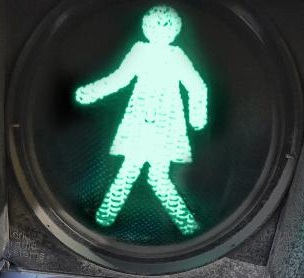
Female Light Signals in Victoria: Equal Lights

I think that while it's quite easy to sit there and criticize a new implementation that has been introduced in Melbourne, it's worthwhile to have a think about it overnight, and wake up the next morning and say, hey, Melbourne, good on you for introducing that new implementation: an additional gendered silhouette:


For those of you who do not know Melbourne, those internationally residing or nationally residing and who have no geographical inclination whatsoever, Melbourne is the New York of Australia, nestled neatly at the bottom of the Land Down-Under, overrun with easygoing cafes and lovely bearded men. And now this lovely urban cesspool of hipsters and blue-collar workers who despise greenies (for those of you who don't know who the 'greenies' are, they are a government party who care for... a lot. They just care so much that others have chosen not to care about them) have another reason to despise greenies, because of this so-called 'embarrassing' attempt at gender equality. The greenie in particular being Misha Coleman, pictured below, the white lady who fell for the 'Green Lady':

The irony. A greenie lady fighting for a green lady. She justified her support of the green lady by saying that, “from when kids are young enough to walk they are given an instruction by a man and it has never occurred to any of us that that is inherently so bias. [...] I’m a mother of two young children and we always talk about waiting for the ‘green man’." So perhaps it is time for kids to wait for 'green woman' too?

One would think that people would be impartial to the adding of a different light. However, much like the whole pushing-forth-gender-equality movement, adding a dress to an otherwise undressed crossing figure has sparked outrage. I have heard the most preposterous reactions to this light, particularly from one fellow who claimed that you have to be dressed like Mary Poppins to cross the road. Well, prior to the installation that light, did you have to be a buff, nude and bald man to cross the road? And if this fellow wishes to further argue, I can argue that he cannot cross regardless, lest he had no toes nor fingers nor a nose because hose are the features that the lit up green and red man lacks. And this 'Mary Poppins' light is not representing Mary Poppins at all, though I do appreciate the fellow's sense of humour: it is a silhouette of Mary indeed, but Mary Rogers, the first female elected to local government. But that is beside the point - that light was added to a suburb in Melbourne, Richmond, in May 2016. It was to commemorate her contributions to council including Victoria's first maternal and child health service - that is to say that this fellow's argument is a year old, redundant, and highly inconsiderate:


And all that fuss over one light - ONE light. Look how happy the fellows above are, why can't this fellow be, too? I mean, really, if that light is so difficult for you to accept, perhaps you should have your social equality epilepsy diagnosed before it grows out of control.


I digress. Back to the topic at hand: Misha Coleman has pushed the idea that gender equality may be accessed through the adding of more female figures in the little boxes that help colour-identifying humans cross the roads as safe and civilized pedestrians. Thankfully for Cr Coleman, the Committee for Melbourne has answered her social prayers, however, much to the dismay of the community of Melbourne.

And, to think, that all the fuss is about an adding to a triangular shape to a male-figure shape in order to entice one's mind to believe in the difference in genders. Behold; from this:


... to this!


If anything, I am outraged that society still expects to represent through semiotics, the presumption that if one were to wear a dress, one is considered a 'female' as opposed to a male who would not, presumably, wear such attire. THAT is something to be outraged over. And one cannot be outraged over that through the adding of these 'female lights' because it would be unwise, as our toilet signs also use the same silhouette to express gender differences when it comes to the public relieving of bowels. So, really, all of the outrage coming from people who think this act does not encourage gender equality is decades too late.

These lights, albeit with their constraining representations of both men and women, bring forth some positive change: "well," said the 'female' light to the 'male' light, "if they expect you to look like that, then I'll sit here because they expect me to look like this, so let's sit here together in harmony and direct these directionless citizens with two colours and hope they don't fuck up the simple task of crossing the road as much as they have fucked up gender equality already. And if they want to call this gender equality, then so be it!"

In that sense, gender equality has certainly been achieved. Both males and females are now suppressed in that they are represented by inadequately dressed (or in the case of the male light, undressed) lit up silhouettes. Now, we should try to help our children listen to both men and women in terms of road-crossing safety, as well as subliminally condition them to believe that a female should look like so, and a male should look like so. 


We are, like the gentleman below, affixing the conditioning of our society to our society. We are restricting ourselves from the freedom of self and expression. While it may have looked as though assigning both female and male lights is a solution to gender equality, we have, paradoxically, added a new negative ingredient to the concoction, instead ensnaring ourselves in a realm which wishes to control.

So, my fellow Melbournians, before you light the fire of outrage, think of what it is that outrages you. Is it the fact that you don't want a female light because adding a female light doesn't really add to gender equality? Or is is the fact that you are distinguishing between a 'female' and 'male' light in the first place?

Maybe, to put both of the above problems at ease, we should instead have LED stick-figures representing us.

Or better yet, a big green and red silhouette of Uncle Sam, to remind us how Orwell predicted the degrading of our society through technology. Not to mention the continued suppression by our government. 1984, people.


Or better yet, a big green and red silhouette of Uncle Sam, to remind us how Orwell predicted the degrading of our society through technology. Not to mention the continued suppression by our government. 1984, people.

But do not hate the initiative. Initiative can bring change. Hate the initiator, because the initiator initiated the wrong initiative. A greater initiative which would have pushed forth gender equality would be equal marriage rights. But we can't do that, because gendered lights at pedestrian crossings are more important to Melbourne and their greenies. Stop caring so much, greenies! Look at what your caring has caused! Social equality epilepsy!


Tuesday, March 7, 2017

Nicki Minaj's Paris Fashion Week Outfit

A woman has exposed her breast to a camera. I repeat: a woman has exposed her breast to a camera.

This exposed breast, albeit with a covered nipple, has enraged fellow humans, owners and non-owners of breasts alike. Onlookers near and far have stared at the freed breast in shock as it hung there in all its bare voluptuousness, hugged by Thierry Mugler; a mound of femininity begging to be regarded. Implied to be an inane display, the person attached to the breast is Onika Tanya Maraj, recognized popularly as Nicki Minaj.

Minaj claimed that, considering she were in Paris, and considering her actions echo that of post-modern art, she would base her outfit on Pablo Picasso's 'La Femme à l'éventail' (1907), translated in English to 'Lady with a Fan'. This piece, coincidentally, was created by Picasso during his 'African Period', which spanned from 1906 to 1909.

source                                                                                             source  

During this period, Picasso's Cubism-rich paintings displayed his temporary obsession with African culture, in particular traditional African masks and African sculptures. The paintings he had completed within this time mainly consisted of women with bare breasts, his crux being 'Les Demoiselles D'Avignon' (1907):


Other works are as follows:

'Nu aux bras levés' (1907)

'Dryad' (1908)

'Trois femmes' (1908)

'Seated Woman (Meditation)' (1908)

'Tête de femme' (1909)

'Buste de femme' (1909)

His exposure of the female breast during this period sparked some people to believe that Picasso was a madman, 'drinking turpentine and spitting fire'. Surely, though, Picasso cannot be seen as a scapegoat. Nor can the many other artists who too sought to display the wonder that is the female figure in the nude in their works:

'Two Girls in the Grass', Otto Mueller, 1919

'Naked Maja', Francisco de Goya, 1800

'Nude (Black and Gold)', Henri Matisse, 1908

'Reclining Nude', Amadeo Modigliani, 1915

'Vanus of Urbino', Titian, 1538

The human body is a delight to regard. It is not obscene, nor is it smutty. It should not be considered a scandal to expose certain parts if one's consent is behind their motive. And what better time to regard the human body than at the Paris Fashion Week?

And have you people forgotten about the 'Free the Nipple!' movement? A movement encouraging equality, empowerment and freedom? Nicki has, in displaying her breast, also displayed that she has equal rights, and that she is empowered because she is free to express herself as she pleases. This is not to incite negative attention, rather to flaunt human expression and freedom. 

Thank you, Nicki, for freeing your breast. Thank you for not listening to societal expectations, and for not allowing yourself to be constrained. Thank you for embodying art, and for embodying change. Thank for your bold move, and for reminding us that it is okay to do as one pleases, without having to think of pleasing others, particularly mainstream media. And thank you for bringing Picasso's visual glory back into the spotlight, as well as art. Art is our savior. Without it, we would be plain, stretched canvases, hung nowhere and exclaiming nothing; making no statements, making no progress.

Ladies, gentlemen, stand in front of your mirrors in the nude and appreciate what you see. Then dress as you please, and attend an art gallery, and appreciate what you see. Jeff Koons would be a great start.

She may have dressed as 'Lady with a Fan', and if I am able to stand next to her, she will definitely too be deemed 'Lady with a Fan'.

FREE THE NIPPLE, AND FREE THE FREER OF THE NIPPLE!

Sunday, July 24, 2016

Pokémon GO: how Evolving Pokémon is Devolving us


Last night, I joined my sister and her partner on a journey through the urban jungle that is Melbourne, looking for additional great spots to discover and catch Pokémon in Pokémon GO. Since it has become most everyone's pastime, in order to feel somewhat of a human connection I have been left with no choice but to bribe fellow persons to spend time with me via luring them into an augmented world. Since joining the sheeple, I have noticed that the only form of 'social time' I have acquired is when we communicate to one another about the spotting of new Pokémon, as well as the locations of the Pokéstops that sit closest to one another so as to spawn more and more of these digital creatures. Ultimately, all form of communication has been used within and for the purpose of excelling within the game, especially when it comes to adventuring to the nearest junk food distributors to re-energize and to leave behind human waste.


But through partaking in this newfound madness, I have found that my need to observe has overcome my need to play, which has lead me to witness firsthand the decay of socializing and of basic human function. Because my endeavors mainly take place on evenings, I have been staring in awe at multiple strangers' faces, aglow with their phone screens, necks strained as heads are bowed in subservience to technological advancements. It is a worrying sight. It is moreso worrying that I have spent so much time seated in the same position with my head down. And to what gain? I am yet to feel fulfilled. If anything, the game is for one minute of pleasure and a lifetime of pain because we have found ways to deter its initial partial objective, which is to explore the world around us, by sitting in a car and driving to locations and waiting for Pokémon to come to us. Despite the obvious mental and physical health concerns, however, my primary concern is that players are spending more time playing the game than considering a creation of their very own. That is the very niche of what it is like to follow rather than lead.

The only people who have impressed me are those who are finding and using special source codes to hack the game in order to spawn their own creatures and discover the game's limitations. Users who perform this are showing a higher level of thinking, one that manipulates an already-made platform so as to render it unique. Another set of impressive people who have revealed themselves in lieu of those who follow are those using the game to commit crimes. In both circumstances, we observe that offenders are ones who divulge from the original intended path that the game was primarily created for. My central argument is that divulging from a set task, divulging from the main activities of the status quo is beneficial for one.


No. I am not condoning illegal actions, rather I am condoning actions that do not leave one to follow, rather to lead. An instance of this within a game occurs in Garry's Mod, a sandbox physics game based on the idea of a literal sandbox: the aim of the game is to create a variant of the game itself by tweaking the virtual world so as to make it your own. As its website states, 'there aren't any objectives - you can't lose, and you definitely can't win'. Firstly, the game boasts the lack of competition. Objective is based on what the player sees fit, and therefore leaves the player in a realm of safety from outside pressures. Here, one is free to perform without the constraints of set goals, maintaining the feeling that anything is possible. And anything is indeed possible, as the game reaches far to the nether regions of each budding player's creativity. It is a collaborative experience, teeming with opportunities to be discovered.


Pokémon GO, in juxtaposition, is based on the premise that you 'gotta catch 'em all', or in the avant garde premise, 'capture as many Pokémon as you can' - but if you as well as millions of others indeed catch them all, then what? Yes, if each of your Pokémon reach the maximum combat levels and you conquer gyms and you catch legendary Pokémon then all you are doing is competing with millions of others with the same objectives, thus making the game painfully repetitive and not at all rewarding. One, in Pokémon GO, only panders to the game's initial objective, straying away from the utter fact that one is constantly repeating motions, duplicating actions and reciprocating two mutual feelings: loss or defeat. Conquering is somewhat impossible for you cannot conquer something designed to leave you scrambling for more. It is in this sense that the game is indeed totalitarian. One is subservient to Niantic and the motives that have framed the most downloaded app in a first week ever.

If anything, the inflation of virtual reality that is Pokémon GO is deflating our sense of humanity. We are struggling to collect little forms of data in order to evolve them into new forms of data and in turn, are devolving ourselves, devolving from our advances. This is surely something to add to our sense of lack of purpose, lack of raisons d'etre, and soon we will reach a new low; though, hopefully the new low will be reached with our dignity, and not with our degenerating postures.

Thursday, July 14, 2016

Pokémon GO: the hunt for Pikachu: a narration by David Attenborough*

A hunched back, an aching neck, legs overworked, both hands grasping the smartphone, eyes glued to its phone screen and all attention waiting on a single beep or a change of pixels, the human is on the prowl for more Pokémon. This human, mind you, has scarcely found initiative to leave its habitat prior to this. It had no reason to leave the comforting glows of its television or computer screen, after just having gotten over the glow on its phone screen. First, Netflix, and now Pokémon GO.

Armed with two portable phone chargers, some in-game incense and Pokéballs, the human makes the call to fellow humans. Together, they enter its automobile and drive at 30mph through its neighbourhood, careful, the driver too, not to miss any Pokémon on their way, and also mindful to cheat the Pokémon egg hatching system. Humans are cunning creatures, outsmarting the smartest of devices in order to exploit what they offer for what seems to be no benefit. At the end of each hunt, each human comes home empty handed, but with a digital archive full of animated rarities. Outside of the vehicle, many other humans can be seen glued to their phones, embarking on yet another day's journey, their young also joining them on their own phones, as offspring so little as just three years old have also joined the journey to be the very best, like no one ever was.

Today, after having spent almost an entire week on their phones, this group of humans is after one particular Pokémon: the ever so elusive Pikachu. This short yellow rodent, stubby in stature, is thunderingly charismatic. Armed with a cute looking face, do not let it fool you for innocence. Stored in its seemingly innocent reddened cheeks are thunderbolts, ready to strike out and smelter any who step in its path. If that's not enough to scare you, perhaps its five tiny fingers at the end of its short arms will. Like Australia's dropbear, the Pikachu has the capability to, in quite a cute manner, erratically claw at you. Luckily, we have sedated one today for the purpose of showing you its features up close. We found it gnawing on a powerline, and my team managed to catch it before a hoard of Poké-trainers rolled in. They are standing by now for its release. What you cannot see, photographed below, is the minute after this photograph was taken, wherein it blasted me to near death after its sedative wore off. You also cannot see its thunder-bolt shaped tail, which follows it swiftly wherever it goes. But what you can see is its tiny little ears, with a black tip on their ends. A mighty creature, so delicate in features. 


After releasing it, we headed back to our campsite behind the field where multiple Pikachu sightings have taken place. This may have to do with the multitude of lures that have been used by avid Poké-trainers. The group of humans observed earlier mumbled harsh nothings to one another. It looks as though they are having an argument. "I'll uninstall, you all better do the same because I don't think either of us will catch one unless we start over!" one screamed. The others seemed to have follow suit. According to our cameraman across the field, he heard them saying something about creating new email addresses and accounts to start this process, a process that has only recently been discovered. This process states that if you abandon all starter creatures over five times, a Pikachu will appear. The humans separated. We followed their ringleader, watching him leave behind several starter Pokémon.


Surely enough, after abandoning Squirtle, Bulbasaur and Charmander five times, the human spotted the Pikachu we caught earlier. Unbeknownst to him, in a few minutes, this field will be teeming with them. But in order to allow him to retain his dignity, and to keep our camera crew safe, we chose not to notify him, and instead, watched him burn off all the calories months of Netflix binging have added to him. The human leapt up in delight with his mouth agape, and screamed, "I GOT HIM, I GOT HIM!"


The humans he came with quickly gathered around him, trying to look at his phone screen. He held it up; a modern day Lion King, and shook. "Throw it!" some yelled. "Quick!" 


The Pikachu, after having thought that its first encounter with these abhorrent humans would be its last, stared in horror as it began to count down its final minutes of freedom. It thought to flee, but it was programmed, once found in the game, to withstand the throwing of three Pokéballs before fleeing. Unable to turn itself away from the group of frighteningly excited humans, it turned towards it potential captor, and decided that the only thing left to do, since this was not a formal Pokémon battle, was fight off his Pokéballs.


And surely enough, it did. The human threw the first Pokéball, and Pikachu swiftly tapped it away. "Shit!" he exclaimed. Another human said to it, "try again! Quick!" Pikachu almost had no time to evade the second, but did just in time. It frowned, and put itself in an attacking stance in order to try to intimidate the humans. But it was outnumbered, and more wannabe explorers joined its human rival, throwing bits and pieces of advice. One bit of advice stood out, "Use a Razz Berry!"


The human complied. He threw a Razz Berry in front of Pikachu. Pikachu hesitated for a while, and then went for the bait. Just as he did, the human decided to throw the third and possibly his last Pokéball with a twist. He placed his finger on the screen, waved the Pokéball in a circular motion, and it leapt up in the augmented air. He threw a curveball. "GREAT" his phone flashed at him. 


Pikachu panicked. His world turned a bright white and then a deep, velvety red. He was trapped inside the Pokéball. He strained. He wriggled. He punched its inner walls and screamed and even thunderbolts, it appears, could not help him. He cried out in surrender. One of my cameramen shed a few tears. This is a sad moment for all digitalised creatures. 


The Pikachu was then registered to the human's Pokédex. "Good work, bro!" "Well done!" "Awesome!" the humans cheered. As hastily as they were to find and capture a Pikachu, so too were they haste in leaving, and moving on to capture yet another. Pokémon all over the world now seem to be in danger of being ensnared in a Pokéball, forever indebted to a life of digital servitude towards humans who too are ensnared in the augmented reality joining the lives of Pokémon and humans alike. 

And in the mere flick of a finger, in a mere miss, in a mere additional flick, in a few mere pieces of advice and a mere  third try, Pikachu too seemed to be just a mere Pikachu to all present onlookers. The once elusive and highly desired Pokémon became just another Pokémon, and soon this game will be just another game. 


*not actually narrated nor transcribed from any narration by David Attenborough. This entire article is completely fictional and hypothetical. Read in the style of David Attenborough's voice to achieve full effect. 

Monday, July 11, 2016

Pokémon GO: augmented economy

Since 1995, kids and kids at heart all over the world have wanted to be the very best, like no one ever was. Armed with Gameboys, Pokéballs and trading cables, young wannabe Pokémasters ventured through pixels of fields of wild Pokémon, hoping to indeed catch them all. As technology developed and new consoles began to take place of the old, Pokémon continued to live on yet lost its state of prominence.

What started as an April Fool's prank named Pokémon Challenge back on the 31st of March in 2014 (see video below), Pokémon GO has most literally taken over the world, both enhancing it and making it weirder. The team at Niantic found a way to merge what we love with what we do all day whilst retaining our sense of mobility. People of the twenty-first century are seldom seen without their mobile phones, and seldom seen away from other technological devices, and are, in turn, lacking movement, lacking exercise and lacking an exposure of the sun - not to mention the lack of a social life, or a physical social life at that. The developers of Pokémon GO, Saturo Iwata, Tsunekazu Ishihara and Tatsuo Nomura have collectively found a way to merge the lack of these human needs into one technological hybrid monster, attracting clusters of fanatics and non-fanatics alike. The three have combined the concept of Pokémon, the use of mobile phone interfaces, along with Google Maps to create a cyber world that nestles neatly into our real life world, allowing users to immerse themselves in a reality that incorporates the realities of their friends and other users, as well as the cyber-reality of several pixelated beings which humans, for some reason, wish to have in their polarised possession.


If there is one thing I have noticed about the new digital craze that is Pokémon GO, it's that these lucky developers have found a successful way to reel in augmented reality into our realities without yet harnessing other popular digital crazes, such as virtual reality (VR). Since its release, Nintendo's stock value has increased. This economic combustion of an app has brought increases that Nintendo have not acquired since 1983, adding a whopping 7.5 billion dollars to its shares, and has been acquiring a daily revenue of 1.6 million dollars. But what does that mean to us, the people who have been sucked into this virtual world? Well, nothing. Yes, you Aussie, New Zealander or American, can shrug it off, because all you did was jump onto your app store, whether you are an iPhone or Android user, and downloaded this eccentric app for free. Who cares, though, right? It's Pokémon and it's awesome and it's yours at the touch of a screen.


It may be hard to believe, but Pokémon GO has even defeated the popularity of social networking monsters Tinder and Twitter, based on recent figures. It seems that chasing and collecting imaginary monsters is more popular than chasing our lives and goals and building our relationships with other people. While this game allows you to be social and to leave the house, it also ensnares you in a world that merely represents your own. 


But I hold mixed feelings about Pokémon GO. While it annoys me that people choose to invest in the abandonment of reality, it still utilises an aspect of reality. People are lacking creativity because of thriving as far as the creative bar that Niantic has raised instead of creating their own modes of existence, however some people are already finding ways to add to this digital jungle. It seems, though, that ultimately, people are veering further and further away from being human and redirecting their journeying towards partaking in a uniform robotic monotonous society. I mean, isn't that what capitalism is all about? This is another example of the nerdy sector of the bourgeoise luring in the nerdy proletariats, but on a far greater scale. Don't be fooled by the so-called 'benefits' an augmented reality has to offer, because at the loss of allowed monthly mobile data, at the stopping of wifi and at the death of your mobile phone battery, you will come to realise that you have not at all actually progressed, and that your digital accolades actually amount to nothing at all. Really, what are you getting out of this, apart from a bout of procrastination from whatever it is that you have put on hold? I wonder what Karl Marx would think of Pokémon GO. 

Pokémon GO.
Capitalism GO.
Humanity GONE.